

Ritual
Tripindi Shradh in Gaya
Tripindi Shradh is done when the shraddha of the ancestors has been missed, or when there is Pitru Dosh. Three pindas are offered in the names of Brahma, Vishnu and Mahesh - the sattvik pinda for Vishnu, the rajasik for Brahma and the tamasik for Mahesh. In Gaya it is performed at Dharmaranya or Gaya Koop.
Tripindi Shradh Cost in Gaya
When should you choose Vistrit Vidhi?
In most cases, Pramukh Vidhi is sufficient. In the case of Pitru Dosh, the prescribed vidhi is the Vistrit Vidhi. Vistrit Vidhi should be chosen only after consultation, when your family’s circumstances and history call for the extended ritual. Tell us about your family and the rites already performed. We will explain the two options before you book.
Pramukh Vidhi
₹15,000per familySamagri & Dakshina Included
The main Tripindi vidhi as the shastras prescribe: sankalp, Tridev pujan, three pinds, tarpan and mantra-path.
- Asan (seating mats for the puja)
- Sankalp
- Pujan of Brahma, Vishnu and Mahesh
- The three pinds, established and offered
- Pitru tarpan
- The prescribed mantra-path
- On-ground support in Gaya
Approx. time - about 3–4 hours
Where - Dharmaranya or Gaya Koop
Steps
- 1.Sankalp, yathanam-gotra
- 2.Pujan of Brahma, Vishnu and Mahesh
- 3.Three pindas - barley, rice, til
- 4.Tarpan and mantra-path
- 5.The pindas given into the well
Crowd - Pitru Paksha - extremely crowded · other days - relatively calm
Optional
- Travel to Gaya
- Accommodation and meals
- Local transport, pickup and drop
- Brahmin Bhoj
- Gau Daan and Shaiya Daan
- Voluntary donations or gifts
Vistrit Vidhi
₹25,000per familySamagri & Dakshina Included
Every step of the Pramukh Vidhi, plus a longer dev-pujan, extra mantra-path, havan, more Brahmins where needed, and special closing rites.
- Asan (seating mats for the puja)
- Every step of the Pramukh Vidhi
- Extended Tridev pujan
- Additional mantra and sukt recitation
- Havan
- Additional Brahmins participating, as needed
- Extended closing rites
Approx. time - about 5–6 hours
Where - Dharmaranya or Gaya Koop
Steps
- 1.Sankalp, yathanam-gotra
- 2.Pujan of Brahma, Vishnu and Mahesh
- 3.Three pindas - barley, rice, til
- 4.Tarpan and mantra-path
- 5.The pindas given into the well
Crowd - Pitru Paksha - extremely crowded · other days - relatively calm
Optional
- Travel to Gaya
- Accommodation and meals
- Local transport, pickup and drop
- Brahmin Bhoj
- Gau Daan and Shaiya Daan
- Voluntary donations or gifts
Both arrangements follow the shastrokt Tripindi Shradh procedure; the difference is the extent of the pujan, the mantra-path, the havan and the Brahmin arrangements.
Your ritual itinerary, from start to finish
- Starts atSankalp, yathanam-gotra
- Pujan of Brahma, Vishnu and Mahesh
- Three pindas - barley, rice, til
- Tarpan and mantra-path
- The pindas given into the well
- Finishes atClosing rites. Brahmin Bhojan is optional and quoted separately.
The booked location is confirmed before arrival. Vistrit Vidhi includes additional pujan, mantra recitation and havan within this sequence; allow about 5–6 hours instead of 3–4 hours.
A car, pickup or drop is not included. It can be arranged and quoted separately.
Tripindi Shradh photographs in Gaya
Photographs from the Vistrit arrangement in Gaya: family prayer, the priest leading pujan and the ritual materials.
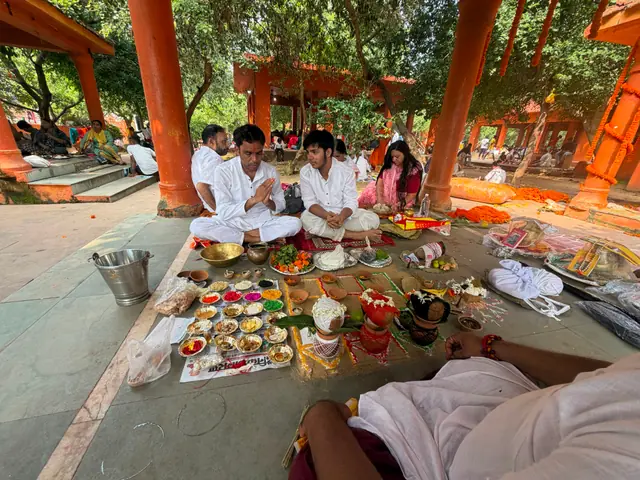
Vistrit Tripindi Shradh in Gaya - a family praying before three kalash and the puja materials 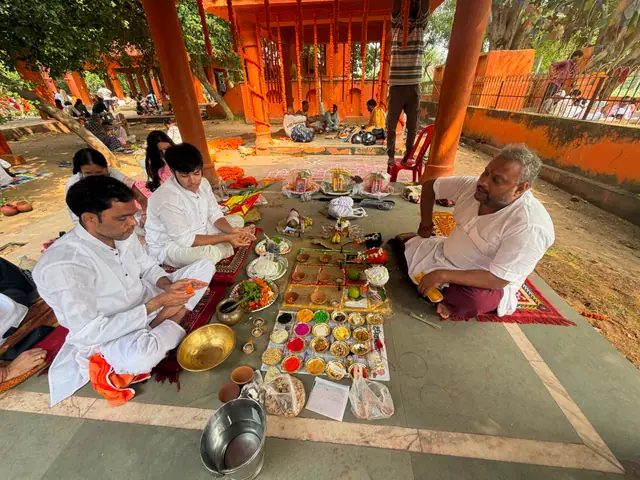
A priest guiding the family through Vistrit Tripindi Shradh puja in Gaya 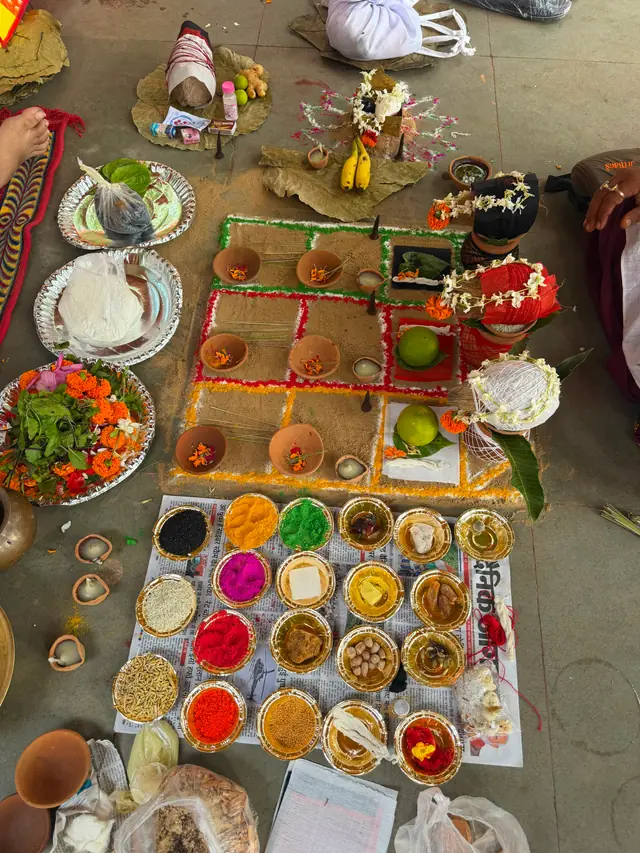
Three kalash wrapped in white, red and black thread, with lamps, flowers and samagri for Vistrit Tripindi Shradh in Gaya
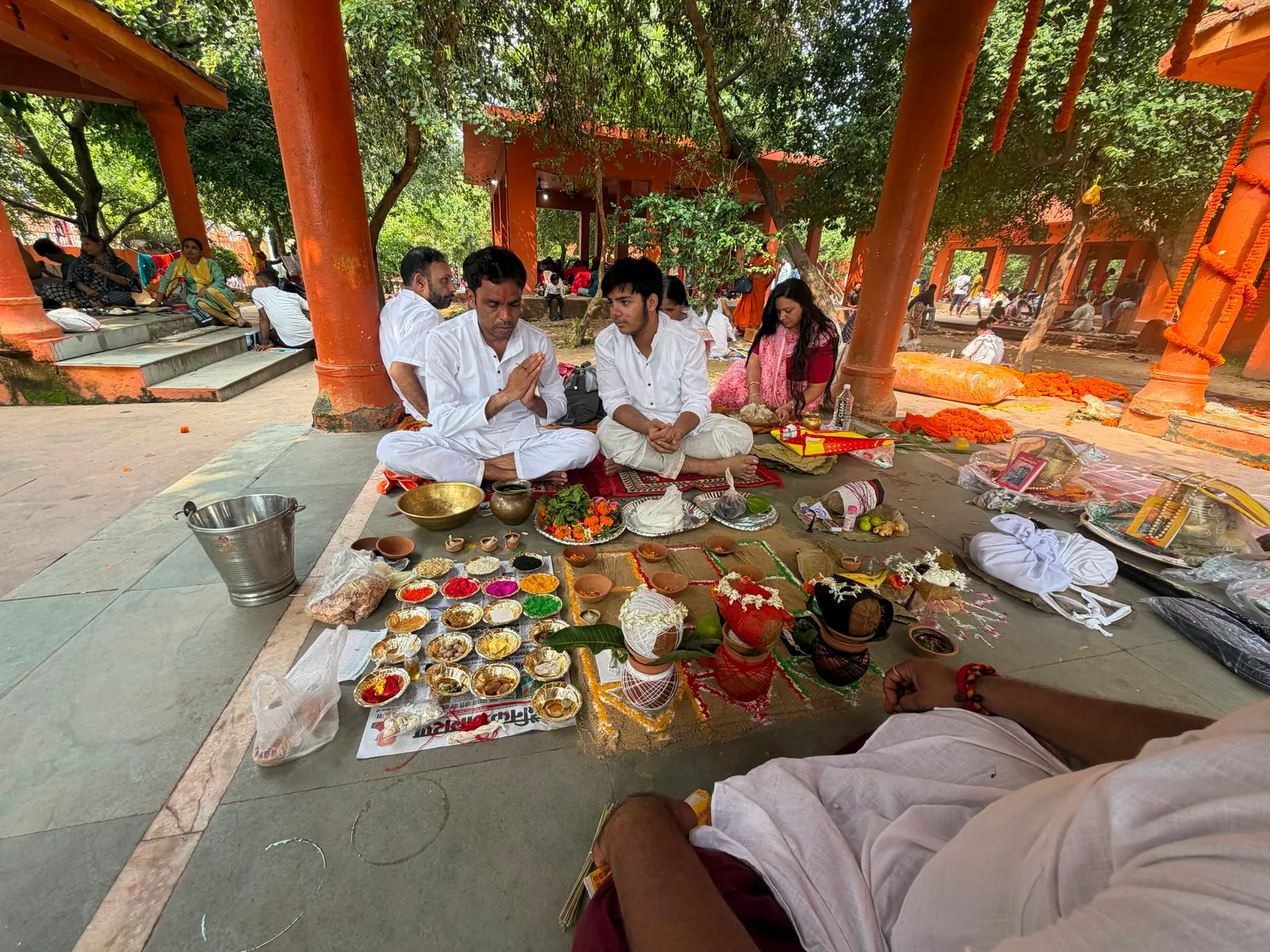
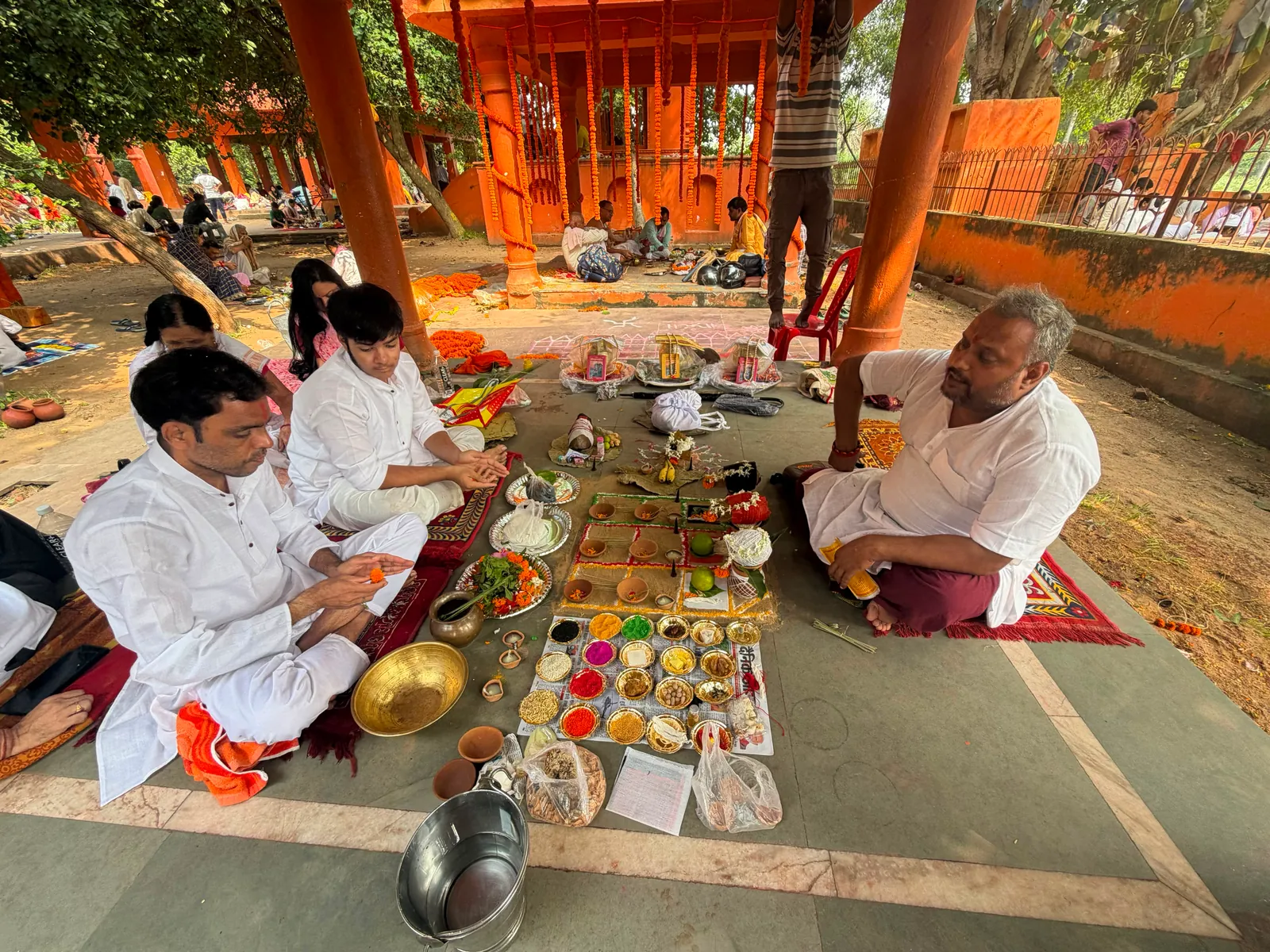
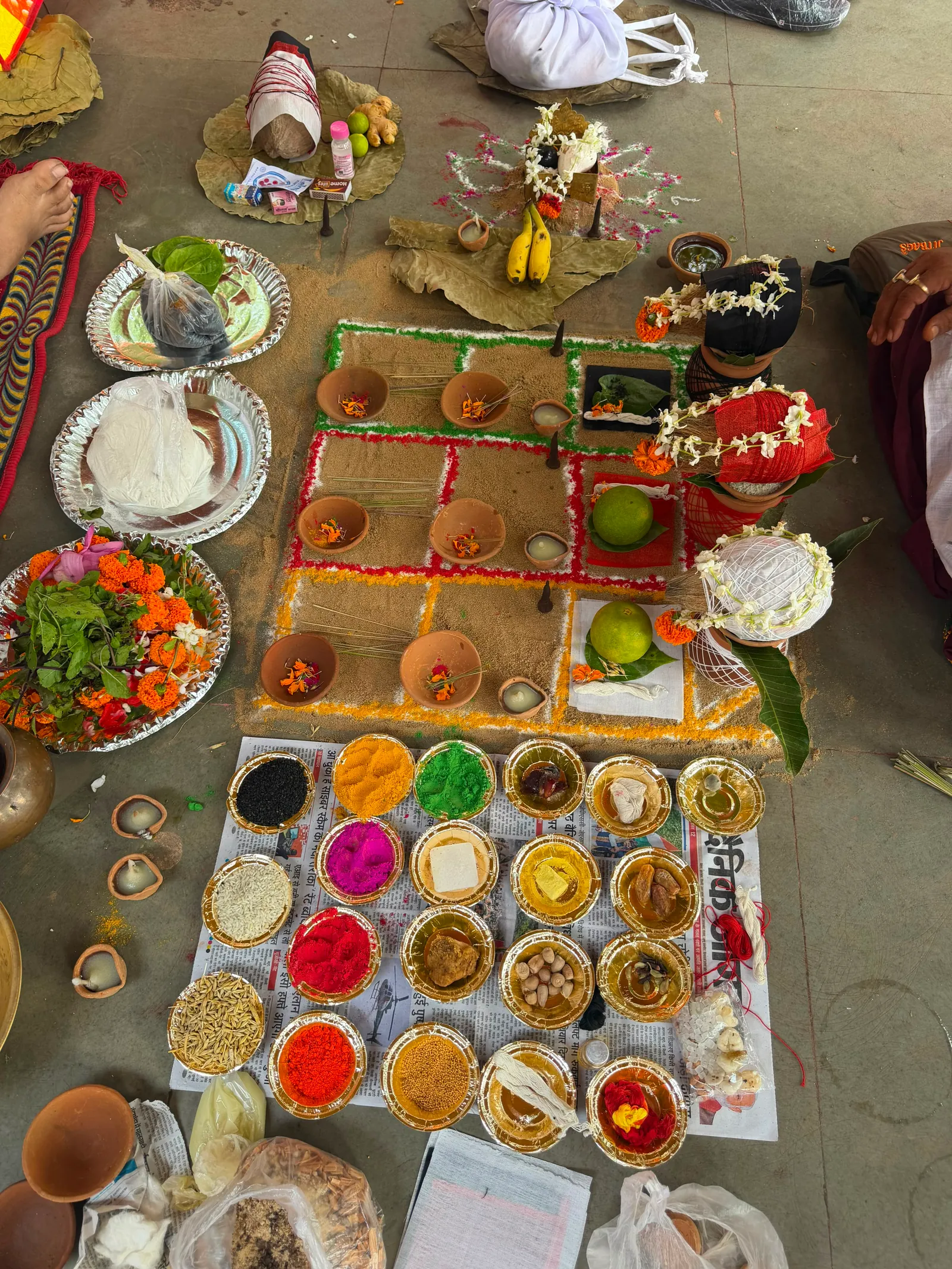
What is the threefold arrangement in Tripindi Shradh?
The Gaya Shradh Paddhati invocations quoted by Sanskrit Documents address departed beings of unknown name and gotra in sattvika, rajasa and tamasa categories, associated with Vishnu, Brahma and Rudra. The three pindas use barley, rice and sesame respectively. This ritual framework should not be equated with three named generations. The linked page is a commentary quoting a ritual manual.
Sanskrit Documents - Yava: quotations from Gaya Shradh Paddhati
What is Tripindi Shradh?
Tripindi Shradh is a shraddha in which three pindas, in the names of Brahma, Vishnu and Mahesh, are offered for departed ancestors, including those whose names and gotras the family no longer knows. It is a kamya shraddha, done for a particular purpose, and is separate from the yearly shraddha on the tithi. In Gaya it is performed at Dharmaranya or Gaya Koop.
Why is Tripindi Shradh done?
Tripindi Shradh is done in two situations: when the shraddha of the ancestors has been missed or left incomplete, or when there is Pitru Dosh. The three pindas are offered for the ancestors, including those whose names and gotras are not known. A Gayawal Pandaji hears the family's circumstances before advising it.
Pramukh and Vistrit Tripindi: choosing the arrangement
The Pramukh Vidhi costs ₹15,000 per family and takes about 3–4 hours. The Vistrit Vidhi costs ₹25,000 and takes about 5–6 hours, with extended pujan, additional mantra recitation, havan and fuller closing rites. Both include samagri and dakshina. Share the rites already performed and the time available so the Pandaji can explain the appropriate arrangement.
The three pindas of Brahma, Vishnu and Mahesh
Each of the three pindas is offered in the name of one deva. The sattvik pinda, of barley, is offered in the name of Vishnu; the rajasik pinda, of rice, in the name of Brahma; and the tamasik pinda, of sesame, in the name of Mahesh. Through them the offering reaches sattvik, rajasik and tamasik ancestors alike, including those whose names and gotras are not known. This threefold vidhi comes from the Tripindi paddhati; the Skanda Purana verses below give the context of offerings for unknown ancestors.
Tripindi Shradh at Dharmaranya or Gaya Koop
Both Dharmaranya vedi and Gayakupa vedi are principal locations in Gaya’s Tripindi tradition. At Dharmaranya the local rite includes offering the pindas into the sacred well. Gayakupa also has an established place in this practice and its own textual association with pinda offerings. The Pandaji confirms the appropriate location and sequence for your family. Ordinary pinda-dana may also take place at these vedis; the location alone does not make an offering Tripindi.
Ritual duration and arrangements in Gaya
Allow about 3–4 hours at the vedi for the Pramukh Vidhi or about 5–6 hours for the Vistrit Vidhi. Travel takes additional time, particularly for Dharmaranya towards Bodhgaya. The cards above explain the scope, materials and dakshina included in each arrangement. Confirm the location, travel and full schedule before booking.
What to wear for Tripindi Shradh
- Men: dhoti, banyan and gamcha. A white kurta-pyjama is also fine. Carry these separately and change into them for the puja.
- Women: a saree. Avoid black or green during the ritual.
- Bring or buy fresh clothes for the puja. These clothes are left behind after the rites.
- If a couple is taking part, carry a long dupatta for the gathbandhan.
Before choosing the rite
Share what you know about your ancestors and the rites already performed. If you want a traditional kundli assessment, you can send the chart for a review. Illness, family conflict or financial difficulties do not by themselves establish a need for Tripindi; a chart reading is a traditional interpretation, not proof of their cause. The Pandaji will explain which rite, if any, fits the family’s circumstances. Read about our tirth purohits or Pind Daan in Gaya.
Scriptural Basis for the Dharmaranya Tradition
Dharmaranya and Gayakupa are principal locations in Gaya’s Tripindi tradition. The Vayu Purana supplies the Gaya context, the Skanda Purana describes offerings for forgotten ancestral identities, and later paddhati literature supplies the three-pinda framework. The passages below explain their relationship without treating them as one prescription. Numbering follows the linked texts.
- What scripture states
- The linked Sanskrit passages and their meanings appear below. A quotation’s context and limits are stated alongside it.
- Later Shraddha / Paddhati literature
- Ritual manuals set out particular procedures. These are identified separately from Purana quotations.
- Established Gaya tradition
- The local locations, sequence and service arrangements describe the Gaya practice followed by Vayu.
- Vayu’s explanation
- Connections drawn between texts and the present rite are explanations, not additional words of scripture.
Dharmaranya in Gaya’s pilgrimage sequence
Original Sanskrit
प्रथमेऽह्नि विधिः प्रोक्तो द्वितीये दिवसे व्रजेत् ।
धर्म्मारण्यं तत्र धर्म्मो यस्माद्यज्ञमकारयत् ॥Meaning
The first day’s procedure has been stated; on the second day one should go to Dharmaranya, where Dharma had a sacrifice performed.
Relevance to the Rite · Vayu’s explanation
Dharmaranya is explicitly part of the Gaya pilgrimage sequence in this text. This is the local geographical context; the verse does not name Tripindi.
Unknown name and gotra: Skanda Purana, chapter 29
The Dharmaranya Khanda’s Lohasura narrative introduces a mantra for ancestors whose identity has been forgotten. The chapter compares its Dharmaranya with Gaya, so it does not by itself establish that the two sites are identical. Its direct contribution here is the textual context for such offerings.
Original Sanskrit
अज्ञातगोत्रनाम्ना तु पिंडमंत्रमिमं शृणु ॥Meaning
The text introduces a pinda mantra for ancestors whose name and gotra are no longer known.
Relevance to the Rite · Vayu’s explanation
This explicitly addresses unknown ancestral identity. The chapter’s Dharmaranya is compared with Gaya in 29.45–48; those comparisons do not establish that it is the Gaya site. The relevance here is the offering’s purpose.
Original Sanskrit
पितृवंशे मृता ये च मातृवंशे तथैव च ।
अतीतगोत्रजास्तेभ्यः पिंडोऽयमुपतिष्ठतु ॥Meaning
May this pinda reach those deceased in the paternal lineage, those in the maternal lineage, and those belonging to ancestral lines whose gotra has passed out of memory.
Relevance to the Rite · Vayu’s explanation
The mantra includes both paternal and maternal lines. Its scope helps explain the correspondence with the later Tripindi invocation of unknown names and gotras; it does not supply the three-pinda procedure.
Original Sanskrit
पितॄणामक्षया तृप्तिर्भविष्यति न संशयः ।
तिलपिण्याकपिंडेन पितरो मोक्षमाप्नुयुः ॥Meaning
According to the text, the Pitrs will have enduring satisfaction, without doubt, and may attain moksha through a pinda made from sesame cake.
Relevance to the Rite · Vayu’s explanation
This is the Purana’s theological result for the offering it describes. Verse 29.67 places that offering before Vishnu on the waning fourteenth tithi in Bhadrapada. It is not a commercial guarantee or the complete calendar and procedure for every modern Tripindi arrangement.
The significance of Dharmaranya’s ancient well
Original Sanskrit
कूपे तर्प्पणकं श्राद्धं शंसंति पितरो दिवि ।
संतुष्टा पिंडदानेन गयायां पितरो यथा ॥
वांछंति तर्प्पणं कूपे धर्मारण्ये विशुद्धये ।Meaning
The Pitrs in heaven praise shraddha with tarpana at the well, just as they are satisfied by pinda-dana at Gaya. They desire tarpana at the Dharmaranya well for purification.
Relevance to the Rite · Vayu’s explanation
Shraddha, tarpana, pinda-dana and the sacred well are directly connected in this narrative. The explicit comparison with Gaya is also why this passage should not be used by itself to identify the two sites.
Original Sanskrit
पूर्व्वं हि ब्रह्मतीर्थं च कूपे श्राद्धादि कारयेत् ॥
तत्कूपयूपयोर्म्मध्ये सर्व्वांस्तारयते पितॄन् ।
धर्म्मं धर्म्मेश्वरं नत्वा महाबोधितरुं नमेत् ॥Meaning
The passage mentions Brahma-tirtha and directs shraddha and related rites at the well. It describes the deliverance of the Pitrs between the well and sacrificial post, followed by homage to Dharma, Dharmeshvara and the Mahabodhi tree.
Relevance to the Rite · Vayu’s explanation
Read with 49.29–31, this is the Gaya text’s context for Dharmaranya and well-side ancestral rites. The connection predates modern pilgrimage businesses. The local Tripindi practice of placing pindas in the well belongs to Gaya tradition; the verse does not make that rite exclusive to this well.
How does this relate to Tripindi Shradh?
The later Tripindi paddhati invokes three categories of departed beings of unknown name and gotra. The linked Sanskrit Documents commentary quotes the Gaya Shradh Paddhati’s invocations and materials. This is evidence from a quoted ritual manual, distinct from the Purana passages above.
Original Sanskrit
अज्ञातनामगोत्राःMeaning
Those whose names and gotras are unknown.
Relevance to the Rite · Vayu’s explanation
Sanskrit Documents’ Yava commentary quotes the Gaya Shradh Paddhati, attributed there to Rudradatta Pathak. Each of its three quoted arghya formulas opens with this expression. The quoted procedure associates Vishnu with barley, Brahma with rice and Rudra with sesame. Our citation is to these quotations; we have not independently examined the printed manual.
| Ritual category | Deity | Pinda material |
|---|---|---|
| Sattvika | Vishnu | Yava / barley |
| Rajasa | Brahma | Rice |
| Tamasa | Rudra | Sesame |
Vayu’s explanation: the Dharmaranya Mahatmya describes pinda offerings for forgotten or unknown ancestors. The Tripindi paddhati likewise addresses unknown names and gotras through three pindas associated with Vishnu, Brahma and Rudra. This correspondence provides scriptural context and helps explain the Gaya tradition. It is not proof that the Skanda Purana calls the rite Tripindi Shradh or prescribes its complete later form.
Why is Tripindi Shradh also performed at Gayakupa?
Gayakupa is a principal location in the established Gaya Tripindi tradition, alongside Dharmaranya. Its relevance is independently supported by the Garuda Purana’s chapter on Gaya, which explicitly praises pinda offerings at Gayakupa. This is a separate source from the Skanda Purana’s Dharmaranya narrative.
Original Sanskrit
आत्मजो वा तथान्यो वा गयाकूपे यदा तदा ।
यन्नाम्ना पातयेत्पिण्डं तं नयेद्ब्रह्म शाश्वतम् ॥Meaning
The text says that when a son or another person places a pinda in Gayakupa in someone’s name, the offering leads that person to eternal Brahman.
Relevance to the Rite · Vayu’s explanation
This chapter concerns Gaya and explicitly names Gayakupa as a place for pinda offerings. Its stated spiritual result is attributed to the Purana. The verse concerns an offering in someone’s name; it neither mentions Tripindi nor gives its unknown-name invocation. The later three-pinda procedure and its use at Gayakupa belong to paddhati and Gaya practice respectively.
Vayu’s explanation: Gayakupa’s textual connection with pinda offerings helps explain its suitability for the Gaya Tripindi tradition. The Purana establishes the sacred setting; the later paddhati supplies the threefold rite; local practice connects them. It does not follow that Tripindi can only be performed at Dharmaranya and Gayakupa. The Pandaji confirms the location for your family. See Gaya’s vedis.
See the arrangements and costs above. For questions about this rite or booking, contact us.
Tell us what you need
What Your Tripindi Shradh Arrangement Includes
What's included
- Pooja as per the shastras, full samagri and dakshina
- Three pindas - barley for Vishnu, rice for Brahma, til with gur for Rudra
- Complete samagri - pind ingredients, sesame, barley, kush and panchgavya
- Tarpan and sankalp for the departed addressed in the Tripindi rite
- Sankalp for unknown names and gotras, as guided by the Pandaji
- Pinda offerings at Dharmaranya or Gayakupa, according to the agreed local sequence
- Recitation of the prescribed mantras for pret-shanti
- Puja items - flowers, incense, ghee lamps, cloth and sacred thread
- Guidance on the vidhi and its right sequence by the Pandaji
- Asan (seating mats for the puja)
Gaya’s hereditary Gayawal priesthood
Gayawal Pandas are Gaya’s traditional pilgrimage priests. Ritual knowledge and relationships with pilgrim families pass from one generation to the next within these priestly families. Historical research documents this family-based priesthood in Gaya over centuries.
History of the Gayawal priesthood: Tirthankar Roy · The Journal of Asian Studies
Pandit in GayaQuestions families ask
Frequently asked questions
What is Tripindi Shradh?
Tripindi Shradh is a shraddha in which three pindas, in the names of Brahma, Vishnu and Mahesh, are offered for departed ancestors, including those whose names and gotras the family no longer knows. It is a kamya shraddha, done for a particular purpose, and is separate from the yearly shraddha on the tithi. In Gaya it is performed at Dharmaranya or Gaya Koop.
Why is Tripindi Shradh done?
Tripindi Shradh is done in two situations: when the shraddha of the ancestors has been missed or left incomplete, or when there is Pitru Dosh. The three pindas are offered for the ancestors, including those whose names and gotras are not known. A Gayawal Pandaji hears the family's circumstances before advising it.
What is the cost of Tripindi Shradh in Gaya?
The listed arrangements cost ₹15,000 for the Pramukh Vidhi and ₹25,000 for the Vistrit Vidhi, per family, with samagri and dakshina included. Travel and stay are extra. Confirm the full scope and agreed amount before payment.
How long does Tripindi Shradh take in Gaya?
The Pramukh Vidhi takes about 3–4 hours at the vedi and the Vistrit Vidhi about 5–6 hours. Allow extra time for travel and confirm the full schedule and location before booking.
Is Tripindi Shradh the same as regular Pind Daan?
No. Tripindi is a distinct kamya rite with a prescribed three-pinda framework. Ordinary pinda-dana also takes place at Gaya’s vedis, including Dharmaranya and Gayakupa. A shared location does not make the procedures identical.
Can it be performed if we do not know our ancestors’ names?
Yes. The cited Tripindi paddhati explicitly addresses unknown names and gotras. Share whatever family information you have; the Pandaji will explain the appropriate sankalp.
Is Tripindi Shradh also performed at Gayakupa?
Yes. Dharmaranya and Gayakupa are principal locations in Gaya’s traditional Tripindi practice. Garuda Purana, Achara Kanda 83.61 independently mentions pinda offerings at Gayakupa. It does not name Tripindi or restrict that rite to these two places.
Why is Tripindi Shradh associated with Dharmaranya?
Vayu Purana, Uttarardha 49.29–33 places Dharmaranya and well-side shraddha in the Gaya pilgrimage sequence. Skanda Purana, Dharmaranya Khanda 29.65–68 gives context for offerings to unknown ancestors, but does not establish the identity of its Dharmaranya with the Gaya site. Together with the later paddhati, these passages help explain the ritual relationship.
Does the Skanda Purana call this rite Tripindi Shradh?
The quoted verses do not use that name. They discuss pinda offerings for unknown ancestral identities and the sacred well. The specific three-pinda framework comes from later ritual manuals; its relationship to those verses is explained separately above.
What does the Skanda Purana say about the sesame pinda?
Dharmaranya Khanda 29.68 associates a sesame-based pinda with enduring satisfaction of the Pitrs and moksha. This is the Purana’s stated theological result for the offering it describes, not a guarantee attached to booking Tripindi.
Start here
Tripindi Shradh - Talk to us
Tell us your family’s circumstances and the rites already performed. We explain the appropriate vidhi, how to prepare and what the ceremony includes. You receive the arrangements and cost in writing before booking.
Prefer to write?Send details insteadOpen this only if convenient. A call or WhatsApp is enough to begin.
Loading form…